
Lost Pet Scams: How to Spot Them and Stay Safe
Published 8 min read
When your pet goes missing, you post everywhere: your phone number, a photo, the street where your pet was last seen, and often a reward. That is the right thing to do. It also means strangers can see that you are worried and want to act fast, and a small number of them are scammers.
This guide explains the scams that police, attorneys general, and the Better Business Bureau warn about most, how to spot each one, and the simple checks that keep you safe while you keep searching.
The short version
- Never send money before you see your pet in person. A real finder does not need payment first.
- Never read back or forward a code that someone texts you. That request is always a scam.
- Ask for a new photo of the pet next to a note with today’s date, or a detail you did not post.
- Meet in a busy public place, or at a vet clinic or animal shelter, and bring someone with you.
- Finders: ask for proof of ownership before you hand a pet over.
Why scammers watch lost pet posts
A lost pet post gives a scammer everything they need: a phone number to text, a photo and description to repeat back to you, and an owner who is under stress. Most of these scammers never had your pet. They read public posts on social media and lost and found sites, then contact many owners at once and wait for someone to pay.
Knowing the common patterns makes them easy to spot. Almost every one of them ends the same way: they ask for money, or for a code, before you have seen your pet.
Scam 1: The "finder" who wants money first
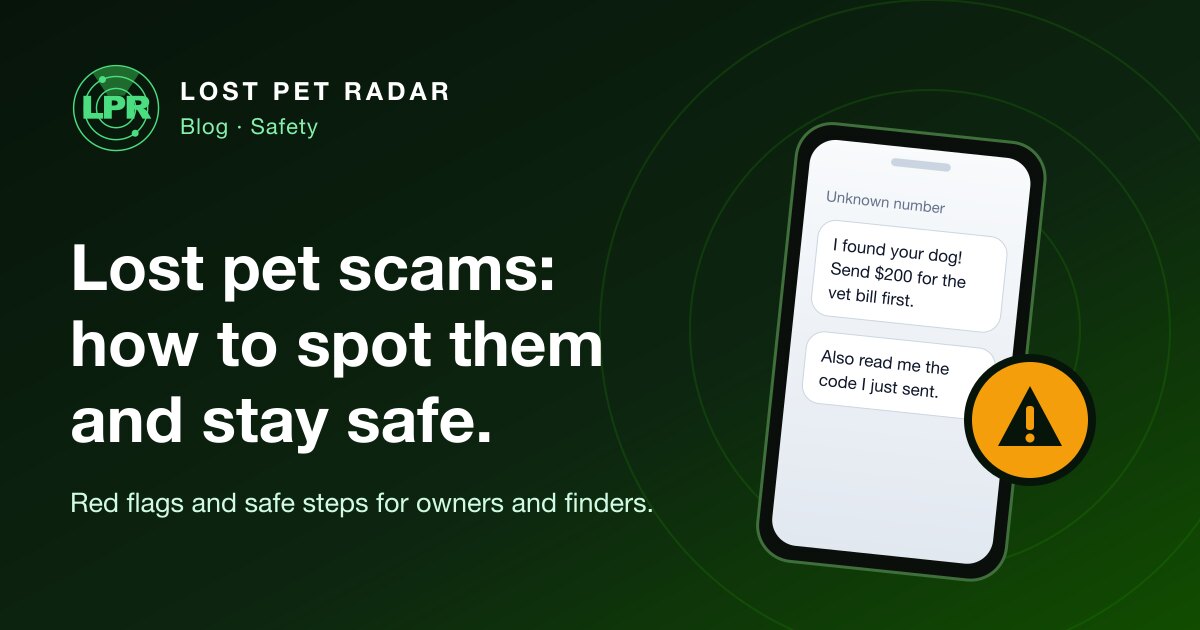
Someone calls or texts to say they have your dog or cat. When you ask for a photo or a detail, they have an excuse: they are out of town, their phone camera is broken, or the pet is at a friend's house. Then they ask for the reward up front, or for money to cover a vet bill, food, or gas, usually by gift card, wire transfer, or a payment app.
A newer version uses a phone number that looks like a local shelter or vet clinic. The caller says your pet was hit by a car and needs surgery right now, and asks you to pay before they will treat it. In a 2025 alert, the Maryland Attorney General described an owner who lost $2,600 this way. The Better Business Bureau reports the same pattern across the country.
What to do instead: hang up and call the clinic or shelter yourself, using a number you find on its official website. A real vet will not hold an injured pet hostage for payment over the phone, and a real finder will not need your money before you see your pet.
Scam 2: "Read me the code I just sent you"
The "finder" says they want to make sure you are the real owner, so they will text you a code and you should read it back. The code does not come from them. It comes from a service such as Google Voice, and reading it back lets the scammer set up a phone number tied to yours. They can then use that number to hide while they scam other people, and they may try to get into your accounts.
The Federal Trade Commission names people who post about lost pets as a main target of this trick, and police in places such as Port St. Lucie, Florida have warned about it too. The rule is simple: never share a verification code with anyone who contacts you. A real finder has no reason to ask for one.
If you already shared a code, follow the FTC's steps to take back your number, change the passwords on your important accounts, and turn on two-step sign-in with an authenticator app where you can.
Scam 3: The truck driver who picked up your dog
This one is an old scam that still works. The caller says they are a long-haul truck driver who found your dog on their route, and they are now hundreds of miles away. They offer to fly or ship your dog home if you wire money for the ticket. After the first payment, new costs appear: a travel crate, food, a health certificate, an airport fee.
The Georgia Attorney General's consumer office and the Volusia County Sheriff's Office in Florida both warn that the caller never had the pet. A story that puts your pet far away, where you cannot go and check, is a red flag on its own.
Scam 4: Paid search parties, "alerts", and pet detectives
Some messages offer help instead of claiming to have your pet: a drone search, a search party, a paid "pet detective", or a service that will call or alert thousands of your neighbors. They ask for a fee first, often a few hundred dollars by payment app, and then nothing happens. The BBB has collected reports of this kind on its Scam Tracker.
Some paid services borrow the name "Amber Alert". They are not part of the official AMBER Alert system, which is for abducted children and does not send alerts for pets. Before you pay any service, look it up on your own, and be wary of glowing comments under an offer from brand new accounts with no location.
A related email says your pet's microchip registration has expired and you must pay to renew it. Call the chip company directly with the number on its official website before you pay anything.
Free help exists. Your local shelter and animal control will take a lost report at no cost, and posting a notice on Lost Pet Radar is free, including the email alerts that go out to neighbors who watch your area.
Scam 5: Lost pet posts that turn into something else
This scam targets the kind neighbors who share lost pet posts. A post shows a lost or hurt dog and asks everyone to share it. Once it has spread, the author edits it into a rental listing, a giveaway, or a link that asks for a deposit or personal details. The Connecticut BBB has warned about these posts on Facebook.
Signs to look for: comments are turned off, the profile is new, or the same photo appears in posts from many different cities. Before you share, check the post's edit history, and look for the original report from the owner or a local shelter.
Red flags at a glance
How to check that someone really has your pet
A real finder wants your pet to go home and will be happy to help you check. Use these steps:
- Ask for a new photo. Ask for a photo of your pet next to a piece of paper with today's date and their first name on it. A scammer who only has the photo from your post cannot do this.
- Ask about a detail you did not post. Keep one identifying detail out of your notice, such as a scar, a white patch on one paw, or a tag color. Ask the caller to describe it.
- Never pay before you see your pet. If you offered a reward, pay it only when your pet is back with you.
- Never share a verification code. No real finder needs one.
- Meet somewhere safe. Choose a busy public place in daylight, a police station lobby, or a vet clinic or animal shelter, where staff can also scan your pet's microchip. Bring a friend or family member, and tell someone where you are going.
- Check on your own. If a caller says they are from a shelter or clinic, hang up and call the number on its official website.
For finders: protect yourself and the pet
Scams can target finders too. Some people claim pets that are not theirs, to keep a friendly dog or to resell it. News reports have found lost pets listed for sale online after someone claimed them. Before you hand a pet over, ask for proof:
- vet records or vaccination papers that name the pet
- several photos of the person with the pet, from different days
- a microchip registration in their name, which a vet or shelter can check with a quick scan, usually for free
- adoption or registration papers
Ask open questions and let them describe the pet first, instead of asking "Is your dog brown?" Do not give out your home address. Meet in a public place, or hand the pet over at a vet clinic or your local shelter, which can confirm the microchip for you. As Petco Love Lost points out, many pets of the same breed look alike, so a matching description is not enough on its own.
Never pay anyone to give a pet back, and never send money to cover the "owner's" costs. If you are unsure, leave the pet with the shelter and let the owner claim it there. Our guide for people who find a lost pet covers the other steps.
If you were targeted, report it
Reporting helps police and regulators spot patterns and warn other owners. You did nothing wrong by trying to get your pet home.
- If you sent money, call your bank, card issuer, or payment app right away and ask if they can stop or reverse it.
- Federal Trade Commission: report at ReportFraud.ftc.gov.
- Local police: use the non-emergency number, especially if money was taken or you think someone has your pet and is trying to sell it.
- BBB Scam Tracker: add your report at bbb.org/scamtracker so others can search it.
- Online fraud: file a complaint with the FBI at ic3.gov, and contact your state attorney general's consumer protection office.
- The platform: report the account or post on the social network or site where the scammer contacted you.
How Lost Pet Radar helps keep you safe
Lost Pet Radar is a free community map of lost pet notices and found pet sightings. A few parts of it are designed with scams in mind:
- Your email address is never shown on the site. When someone uses the contact button on your notice or sighting, we send you their message by email, with the contact details they chose to share. Your own address stays private until you decide to reply.
- You choose who to answer. You can read a message, run the checks above, and ignore it if anything feels wrong.
- Posting and alerts are free. We will never contact you to ask for money to find your pet. A message like that is not from us.
If your pet is missing now, our step-by-step guide for a lost pet walks you through the first hours and days.
Sources and further reading
- Federal Trade Commission: The Google Voice scam: how this verification code scam works and how to avoid it
- Better Business Bureau: Lost pet? Watch out for this scam
- Maryland Attorney General: Consumer alert: beware of scam targeting owners of lost pets
- Georgia Attorney General, Consumer Protection Division: Scams involving lost pets
- Volusia County Sheriff's Office: Lost your pet? Watch out for the scam
- WQCS: Port St. Lucie Police: beware of the lost pet scam
- WFSB: BBB: be on the lookout for bait-and-switch lost pet schemes on Facebook
- Petco Love Lost: How do I verify ownership of the pet when someone comes forward to claim?